
Independent manufacturing research · India
Making Manufacturing Operations More Visible.
Exploring practical ways to improve production tracking, machine uptime, and shop-floor visibility through software and technology.
- Production visibility
- Machine downtime
- CNC & auto-component operations
Research focus
Practical questions from the shop floor
Each article starts from a problem plant heads and production managers face every shift, and separates what is established from what is still being tested.
-
Why production visibility matters in manufacturing
What visibility means for operators, supervisors and owners — and why a planned vs actual gap is often discovered only at shift end.
-
Understanding machine downtime tracking
How stoppages are recorded, why reasons get lost, and what a practical downtime record should capture.
-
Browse the full research library
Filter articles by topic: production monitoring, downtime, reporting and CNC operations.
Manufacturing challenges
Four problems that keep appearing
These are widely discussed challenges in small and mid-sized Indian plants, and the focus of this research. Each is documented with business implications, current methods and open research questions.
-
Production visibility
Shortfalls against plan are often known only after the shift, when the options left are overtime or explanations.
Production visibility challenge -
Machine downtime
Stoppages are recorded as totals with vague reasons, which makes repeat losses hard to see and fix.
Machine downtime challenge -
Manual reporting
Data written on paper is retyped into Excel hours later, introducing delay and transcription errors.
Manual reporting challenge -
Management visibility
Owners receive summaries without the reasons behind them, so decisions rely on phone calls and memory.
Management visibility challenge
Research approach
Understand first, build second
Software that ignores how a shop floor actually works often struggles to be adopted. The work follows four deliberate steps.
-
Listen to the people who run the floor
Conversations with owners, plant heads, supervisors and operators about how production is planned, tracked and reviewed today.
-
Map how information travels
Trace a production figure or a breakdown from the machine to the decision-maker, noting every hand-off and delay.
-
Prototype the smallest useful tool
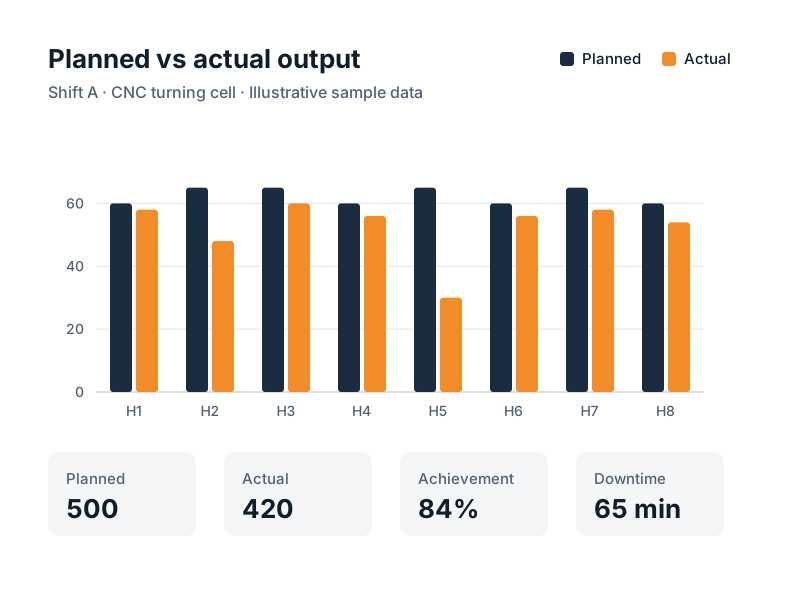
Build simple, testable concepts — such as an hourly planned vs actual view — instead of a full system nobody asked for.
-
Validate honestly and publish
Share what worked, what did not, and what is still a hypothesis. Case studies are published only after genuine deployments.
Current research focus
How late is production information, and does earlier information change decisions?
The research began in January 2026 (see the research journey). The present phase concentrates on CNC machining and auto-component units, where shift targets are clear and losses from setups, tool changes and material waits are frequent.
Questions being explored now
- How long does a shift's output figure take to reach the production manager and the owner?
- Which stoppage reasons are recorded reliably, and which are lost?
- Is an hourly planned vs actual comparison at the bottleneck machine enough to change decisions within the shift?
- What is the least effort an operator can spend recording data that is still useful?
Product experiments
Interactive prototypes, clearly labelled
Three working concepts explore what useful production monitoring could look like for a small plant: a production monitoring dashboard, machine downtime reporting and production performance insights.
They run entirely in your browser with sample data, so plant teams can react to something concrete rather than a slide.
- Planned
- 500
- Actual
- 420
- Achievement
- 84%
- Downtime
- 65 min
- Rejections
- 12
- Gap to plan
- 80
Experimental concept — sample data only. Not a live factory deployment.
Industry conversations
Questions worth discussing with plant leaders
The research depends on conversations with people who run production. These are the questions currently being asked — your answers can change the direction of the work.
-
At what time do you find out yesterday's actual production?
For owners and plant heads — measuring the real delay between the shift and the decision.
-
What were the top three reasons your machines stopped last week?
For production managers — testing whether downtime reasons are known or guessed.
-
How many times is the same production figure written or typed?
For supervisors and office teams — counting hand-offs from register to report.
-
What would you do differently if you knew about a shortfall two hours earlier?
For everyone — testing whether earlier information would actually change decisions.

About the initiative
Research that starts on the shop floor
Shopfloor Insights is an independent initiative by Nilesh Wagh, a manufacturing operations researcher. The goal is to understand how plants track production and downtime closely enough to identify practical improvements that plant teams would actually use.
There are no inflated claims here: no invented clients, no fake results. Research is published as it develops, and prototypes are labelled as prototypes.
Run a plant or production team?
A 20-minute conversation about how production is tracked in your plant would directly shape this research. No sales pitch — just questions about the shop floor.